

If you’ve ever sat through a church council or finance committee meeting, this might sound familiar. Someone asks how much is left in the building fund. Another person wants to know whether the youth mission trip stayed within budget. The treasurer starts flipping between reports, trying to piece together the answer.
The numbers aren’t necessarily wrong. They’re just organized in a way that doesn’t match how the church actually operates, and that’s one of the biggest differences between church bookkeeping and bookkeeping for a typical nonprofit.
On paper, churches and nonprofits have a lot in common. They’re both tax-exempt organizations, they both rely heavily on donations, and they both answer to a board or governing body instead of an owner. Once you get into the bookkeeping, though, the similarities start to fade. Churches have their own reporting needs, their own challenges, and some very unique accounting situations. If QuickBooks isn’t set up with those differences in mind, even accurate bookkeeping can produce reports that leave church leaders scratching their heads.
At a high level, here’s what makes church bookkeeping different from bookkeeping for a typical nonprofit. If you’re short on time, this overview captures the biggest differences at a glance.
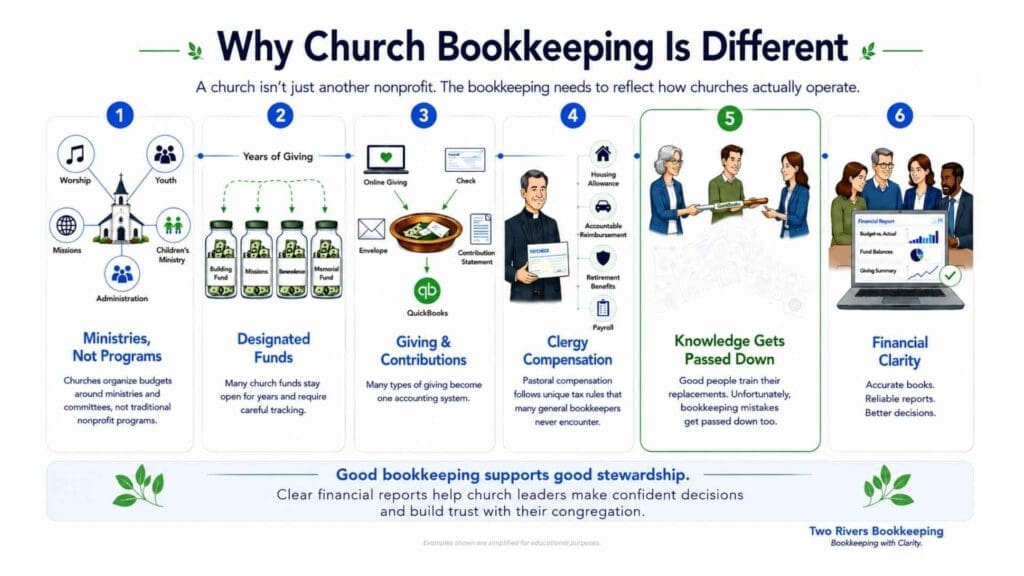
Now let’s look at how those differences affect the way QuickBooks should actually be set up.
Most Churches Don’t Have an Accounting Department
One of the biggest differences between churches and most organizations isn’t found in QuickBooks. It’s found in the church office. Most businesses expect to hire accounting staff. Most churches don’t. Instead, bookkeeping often falls to a faithful volunteer treasurer, a part-time office administrator, or someone who simply said “yes” when they were asked to help.
There’s absolutely nothing wrong with that. Some of the best church bookkeepers I’ve worked with weren’t accountants by training. They cared deeply about their church, were incredibly organized, and wanted to do things the right way. The challenge isn’t commitment. The challenge is expecting someone to become an expert in QuickBooks, reconciliations, designated funds, contribution tracking, clergy compensation, and financial reporting while they’re also answering phones, preparing bulletins, coordinating volunteers, or serving on multiple committees. That’s a lot to ask of anyone.
Churches Are Organized Around Ministries, Not Programs
A typical nonprofit is usually organized around programs. A food pantry might have separate programs for food distribution, nutrition education, and community outreach, and those programs become the focus of budgeting and financial reporting.
Churches usually think differently. Instead of programs, they think in terms of ministries and committees: worship, youth, children’s ministry, missions, hospitality, building and grounds, music, women’s ministry, and on down the list. The finance committee doesn’t usually want to know how much was spent on “Office Supplies.” They want to know how much the Youth Ministry spent compared to its budget.
That difference matters when QuickBooks is first set up. A traditional nonprofit setup often relies heavily on Classes to track programs, and that works well for many organizations. For many churches, though, using Classes for every ministry creates reports with so many columns that they become difficult to read. One approach I often recommend is organizing the chart of accounts around the ministries themselves, with related expense categories underneath as subaccounts. The reports tend to read much more naturally because they reflect how the church actually talks about its finances.
There isn’t one perfect setup for every church. Every congregation is a little different, and the important thing is making sure your reports make sense to the people reading them.
Church Funds Are Different From Nonprofit Grants
This is another place where churches often get compared to nonprofits even though they operate differently. Many nonprofits receive grants, and a grant usually has one funding source, a specific purpose, reporting requirements, and an end date. Church funds often stay open for years, sometimes decades.
Think about a building fund that’s been around since the last addition was built, or a memorial fund where families continue making gifts year after year. Benevolence funds, scholarship funds, mission funds. These aren’t temporary projects. They’re ongoing parts of church life.
Some funds are donor restricted, meaning the donor has specified how the money must be used. Others are board designated, meaning church leadership has chosen to set money aside for a future purpose. Both deserve careful bookkeeping, but donor-restricted funds require especially close attention because the church has a responsibility to honor the donor’s intent.
Church leaders usually want answers to two simple questions: how much has gone into this fund, and how much is still available? QuickBooks can answer both, but only if it’s set up correctly. I’ve seen churches keep separate checking accounts for every fund because it seemed like the easiest way to keep everything straight, and it usually creates more work instead. I’ve also seen churches with perfectly good bookkeeping but no easy way to tell the council how much remained in the memorial fund, because the reporting wasn’t built correctly from the beginning. Neither situation is uncommon.
It’s also worth remembering that some of these funds function as the church’s safety net. If you want to go deeper on that side of things, my post on why your organization needs emergency reserves walks through how to think about setting money aside and protecting it.
QuickBooks is Only as Good as the Setup
One thing I tell clients is that QuickBooks is a fantastic tool, but it’s only as good as it’s setup. It doesn’t know you’re a church. It only follows the structure someone gives it. If the chart of accounts doesn’t reflect how your ministries operate, the reports won’t either. If designated funds aren’t set up correctly, QuickBooks won’t fix them later. And if duplicate accounts have been added every time a new treasurer came along, the software will happily keep using all of them.
I’ve reviewed church files with hundreds of accounts because each new person added another account instead of asking whether one already existed. QuickBooks wasn’t the problem. The setup was.
Giving Looks Different in a Church
Churches don’t just record donations. They record weekly offerings, online giving, memorial gifts, designated gifts, special offerings, mission collections, capital campaigns, and sometimes multi-year pledges. Every gift needs to be recorded accurately so the financial statements stay accurate and members receive correct year-end contribution statements.
That isn’t just good bookkeeping. It’s good stewardship. People trust that gifts designated for a mission trip, the building fund, or benevolence ministry will be used for that purpose, and accurate records help demonstrate that trust has been honored. They also make year-end contribution statements much easier to prepare and help ensure donors have the documentation they need for tax purposes.
Clergy Compensation is Its Own World
This is probably the area that surprises churches the most, because clergy compensation doesn’t work like standard payroll. Housing allowances, accountable reimbursement plans, retirement benefits, special tax rules. Most bookkeepers who work with small businesses never run into these situations.
I’ve talked with churches that assumed payroll was payroll until tax season raised questions nobody knew how to answer. That’s not a criticism of the person doing the books. It’s simply a reminder that church bookkeeping has some unique rules that deserve specialized knowledge.
The Hidden Cost of Turnover
This may be the biggest challenge churches face. Most bookkeeping mistakes don’t start because someone was careless. They start because someone was trying to help. The outgoing treasurer trains the incoming treasurer. The office administrator shows the next office administrator where everything is. A volunteer explains how they’ve always entered deposits. Nobody questions the process because everyone assumes the previous person knew what they were doing.
I’ve heard some version of this countless times: “That’s how the last treasurer showed me.” After a few handoffs, nobody remembers why something is done a certain way. They just know that’s how it’s always been done, and the original mistake quietly becomes the standard procedure.
Maybe the building fund has never reconciled quite right. Maybe a ministry budget was set up awkwardly years ago. Maybe the chart of accounts has grown to 450 accounts because nobody wanted to delete anything. None of those problems happened overnight. They happened one well-intentioned handoff at a time.
QuickBooks doesn’t know the difference between a long-standing tradition and a correct accounting method. If something was set up incorrectly ten years ago, it’ll keep repeating the same mistake for another ten unless someone steps back and asks whether there’s a better way.
Why Outsourcing Often Makes Sense
Some church leaders hear the word outsourcing and picture giving up control of the church’s finances. That’s really not how it works. Your church still approves every payment. Your finance committee still reviews the reports. Your council still makes the financial decisions. An outsourced bookkeeper simply keeps the records accurate, reconciles the accounts, prepares the reports, and keeps everything consistent from month to month.
That consistency matters. Board meetings become easier because everyone is looking at reports they understand. Volunteer treasurers spend less time trying to troubleshoot QuickBooks. Pastors spend less time answering accounting questions and more time focusing on ministry. And when a volunteer steps down or an office administrator retires, the bookkeeping process doesn’t walk out the door with them. The knowledge stays with someone whose job is to maintain it.
For many churches, that’s one of the biggest benefits of outsourcing. If you’re weighing what that kind of help looks like, our guide to professional bookkeeping support covers what to expect and how to know when it’s the right fit.
Good Bookkeeping Supports Good Stewardship
Church bookkeeping isn’t about creating perfect spreadsheets. It’s about stewardship. Church members trust that their gifts will be handled responsibly. Finance committees need reliable information to make wise decisions. Pastors need reports they can understand without translating accounting language. When the books are organized well, board meetings spend less time sorting out numbers and more time talking about ministry. That’s exactly how it should be.
The Bottom Line
Churches and nonprofits have a lot in common, but once you get into the bookkeeping, the differences matter. Ministry-based budgeting, long-term designated funds, contribution tracking, clergy compensation, and volunteer turnover all call for a bookkeeping system that’s designed for how churches actually operate.
If your church has been using the same QuickBooks file for ten or fifteen years, there’s a good chance it’s carrying around decisions that no longer make sense. That doesn’t necessarily mean you need to start over. Sometimes a few thoughtful changes are enough to make your reports clearer, your board meetings easier, and your next treasurer’s job much simpler.
That’s the kind of work I enjoy helping churches with. You can learn more about how I support churches and faith-based organizations if you’d like to see what that looks like. Because good bookkeeping isn’t just about balancing the books. It’s about giving church leaders confidence in the numbers so they can focus on what matters most.
What Working Together Looks Like
I provide virtual bookkeeping support for churches, synagogues, and places of worship that want clarity and consistency in their financial systems. Whether I am completing a QuickBooks cleanup or managing ongoing monthly bookkeeping, my approach is organized, steady, and transparent.
You will always understand what is being done, what information is needed from you, when your reports are ready, and what your numbers are showing. Financial reports should not feel confusing or out of reach. They should help you make informed decisions with confidence.
Communication is direct and professional. Questions are welcomed. Processes are clearly outlined. There is no jargon and no judgment. If your books are behind or feel overwhelming, we simply work through them methodically.
The goal is not just accurate bookkeeping. It is a financial system you can rely on.